
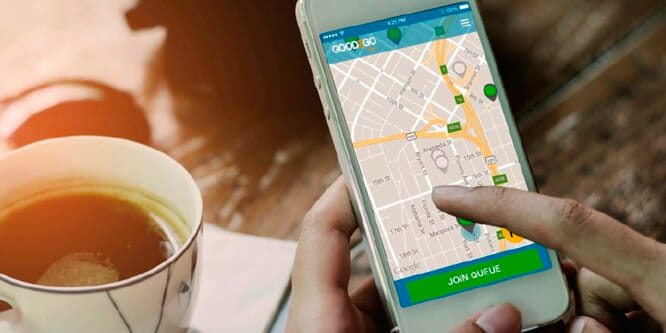
Photo: Good2Go
Can mobile apps put an end to disgusting store restrooms?

Mobile app developers have focused on many aspects of the in-store experience and so it may seem reasonable that some are now addressing an area that can have a significant influence on customer satisfaction.
Last September, Good2Go, a San Francisco start-up, launched what it claims to be first app that locates and grants access to “modern, safe, hi-tech restrooms at retail partners.” Consumers find a location, join a virtual queue, see their estimated wait time, and unlock the restroom door through Bluetooth or QR code. Users must be inside the store location to reserve a restroom.
The service, launched in San Francisco and expected to land in New York City in 2018, is currently free, but daily passes for $2.99 and monthly passes for $19.99 are planned. It’s expected to particularly appeal to travelers, parents and the on-demand work force.


For its retail partners that so far include Whole Foods and a number of coffee shops, Good2Go converts their restrooms to smart rooms featuring “touchless” lights, sinks, hand dryers and toilets, all operated by waving hands across sensors. App users can alert the establishment if the restroom is dirty or has other issues.
John Elstrott, former chairman of Whole Foods and an investor in Good2Go, said in a statement, “Their business model is highly attractive, scalable and offers retailers a digital platform to acquire new customers, drive new revenue and to optimize store-front operations.”
Other apps supporting the restroom experience include Charmin’s SitOrSquat and the just-released “Got to Go” app from Cintas Corp., the provider of work uniforms as well as cleaning and safety solutions. Both enable users to find a local public bathroom, offer a review and see whether it’s likely clean.
With the “Got to Go” app, users can rate the condition of the facility (dirty or clean), supply level (low or well-stocked), smell (good or bad) and whether it’s open to the public or available to customers only.
According to a past Cintas survey, when asked what specific types of businesses participants would avoid if they encountered dirty restrooms, restaurants came in first at 79 percent, followed by hotels (79 percent), health care facilities (77 percent), supermarkets (50 percent), retail stores (45 percent) and gas stations (45 percent).
- Launching Today In San Francisco: The Good2Go App Grants Access to State of the Art Restrooms Located at Retailers in Major Cities – Good2Go
- Good2Go
- When Mother Nature Calls, Cintas Comes to the Rescue – Cintas
- You’ll never use a filthy public bathroom again if this start-up has its way – CNBC
- Gotta go? This app helps users find clean public bathrooms – USA Today
- Charmin Introduces New and Improved SitOrSquat Restroom Finder App – Procter & Gamble/Business Wire
- Customers Spend More At Establishments with Clean Restrooms – Convenience Store Decisions
- Healthy Handwashing Survey – Bradley Corp.
Discussion Questions
DISCUSSION QUESTIONS: Can apps and smartphones solve problems that have long plagued the restroom experience at retailers and restaurants? Where do you see the biggest benefit for retailers as well as consumers?
Poll
BrainTrust

Paula Rosenblum
Co-founder, RSR Research

Joanna Rutter
Marketing, Dor

There’s a market for anything, but I don’t see a sustainable business for paid restroom access. For some travelers and moms, there’s a benefit in finding clean bathrooms fast. Most people though don’t want “yet another app” for something somewhat unnecessary.
Any store that either makes their facilities only available for a fee or premium facilities only available to app users, etc., needn’t waste time and touch the third rail right now.
Retailers charging customers to use their restrooms … really? If this catches on, look for the airlines to start using these apps. If a retailer is going to provide restrooms for its customers, they should be free and they should be clean. This convenience is a cost of doing business and makes your customers feel welcome.
App, shmap! I once walked a store with the president of the company and, when he saw a small piece of trash paper on the store floor, he bent down, picked it up and disposed of it. When the culture of the head of the company dictates that you will have clean bathrooms (this has to be an obsession), you will have clean bathrooms. Most attitudes are passed down from the top; cleanliness, service with a smile, neatly stacked or hung merchandise — everything! We don’t need apps for that.
I don’t know about this. Perhaps, when you are traveling by car and have many options, but come on, any business that does not pay attention to their restrooms is not a business I want to patronize. Period.
I was sort of gobsmacked when we included a question “Given that money is, of course, an issue, what three in-store problems are you most likely to tackle?” and “cleaner stores” was the second most frequently cited opportunity.
I mean, how did this become a thing? Why do we need an app to tell us where to find bathrooms that are clean? That’s nuts. And then retailers fret that business is moving online? My bathroom is clean at home. This is not rocket science. It’s retailing 101.
Have-to-pay restrooms will be a trend only when they also serve refreshments. That said, some customers would probably support an app that would allow them to report an unsavory restroom experience.
Apps have to be practical and useful. I am imagining somebody waiting in line without having used the app and another person who used the app “Good2Go” just circumventing the line, using a virtual fast track and enters the restroom first. It might be convenient for the person using the app but it will certainly create anger and dissatisfaction for the ones standing in line. So since it potentially makes one group happy and the other one angry I question how successful the app will be.
I see this as being used by the homeless population more than travelers. When we opened a store in Santa Monica, within two hours we had a line — it turns out the homeless use either library computers or cell phones to alert each other when there are clean bathrooms. If they can buy a pass, it does not enhance the retail business. And I know of no one who has ever talked to me about finding disgusting store bathrooms as a topic of frustration or concern.
There is literally an app for everything, and the Good2Go restroom app proves that. Retailers and restaurants that focus on the overall customer experience, simply should as part of their business provide a clean and safe environment across the entire selling floor, restaurants etc. Touchless technologies are becoming the norm, and seem to be solving some of the issues.
It’s not clear if there are any real benefits to yet another app for a service that should be expected.
I’m not sure exactly what this is doing for me. I like the idea of finding which bathrooms are available or maybe less crowded but giving me a number in a queue? How does one manage that? Would all the doors have to be locked or only those with apps can use the bathroom? On the other hand, it would be great to be able to let someone know if the bathroom needs servicing. There may be a concept in there for parts of it so let’s see where it goes. For my 2 cents.
Whole Foods is supposedly a premium proposition. I do not expect to pay for restroom access. In actuality, I think regardless of the price point, most shoppers expect chains to provide restrooms for free. Changing that perception will be very challenging.
As to keeping restrooms clean, how about good old-fashioned common sense? Have a cleaning schedule and stick to it. It’s not difficult, and it certainly doesn’t need a technical solution. It just needs a bit of effort and care!
Isn’t having a clean bathroom a basic good business practice? Why do we need an app for that? I suppose the logic is that consumers will be drawn to your store based on a good review, but where’s the connection to that consumer buying something? Unless you’re selling toilet paper. There’s your touchpoint.
If commercial restrooms were generally clean and plentiful, there would be no need for apps like this. Perhaps bad reviews will shame some operators into maintaining and cleaning their restrooms better.
Any question that starts with “can mobile apps put an end to” can be answered with a “probably not!” Especially when the problem it’s seeking to solve is so basic and treatable with better store traffic data. Invest in being more data-driven about how often to clean your bathrooms and saving operational costs while doing so, then maybe we can talk about magic bathroom stalls. This isn’t even touching on how socially troubling it is to commode-itize (see what I did there?) such a basic human need. Sounds like an inane solution that doesn’t address the underlying reality that many retail stores aren’t even hitting a baseline of being pleasant or even bearable anymore, and how large cities like San Francisco and NYC lack adequate public restroom facilities in high-volume areas. This is a customer service and city planning problem. Let’s fix that first before app-ifying it.
Wow. Are we serious? Yep, there’s an app for that! OK, let’s all just take a step back and breathe.
*sigh*
Retailers must take the maintenance of restrooms as a cost of doing business. Just like keeping the lights on. If they don’t people won’t continue to shop there. Let’s keep this simple.
If you shine a spotlight on any part of the business, there’s a high probability of achieving desired outcomes. It doesn’t matter if that spotlight is digital or not; or if the object is clean restrooms or stocked shelves. You just need to weigh the costs and benefits, and be very clear about what you want to achieve and why.
Turning clean restrooms into an in-store process that requires smart mobile devices and digital access is interesting but also creates its own problems. Not everyone in the store will have a mobile device or be receptive to being forced to download the app. Can you imagine the privacy concerns about your restroom usage?
Technology today is highly integrated into what we do. No doubt it can be a wonderful and revolutionary element in enhancing our lives. Should it really become your restroom gatekeeper?
As they say; a solution in search of a problem! Technology for technology’s sake? I see an opportunity for an “infomercial” sponsored by your friendly makers of toilet tissue.
I just did a quick poll around the office and 100% of the Millennial women think it’s a brilliant idea and grabbed their phones to find if it’s available in Houston.
Finding a clean, available bathroom when shopping can be challenging. Notwithstanding all the issues raised, Good2Go seems like a pretty interesting idea.
Wait, they want me to pay $20/mo to help find a clean “hi tech” washroom? Please, Tom, tell me you left out the part where, just like with the Xmas ads, you’re auditioning stories for an April Fools spoof.
But, if worse should come to worst and this is true, my answer is no, this won’t “solve” (whatever) problems exist … you just need to go in with a mop more often.